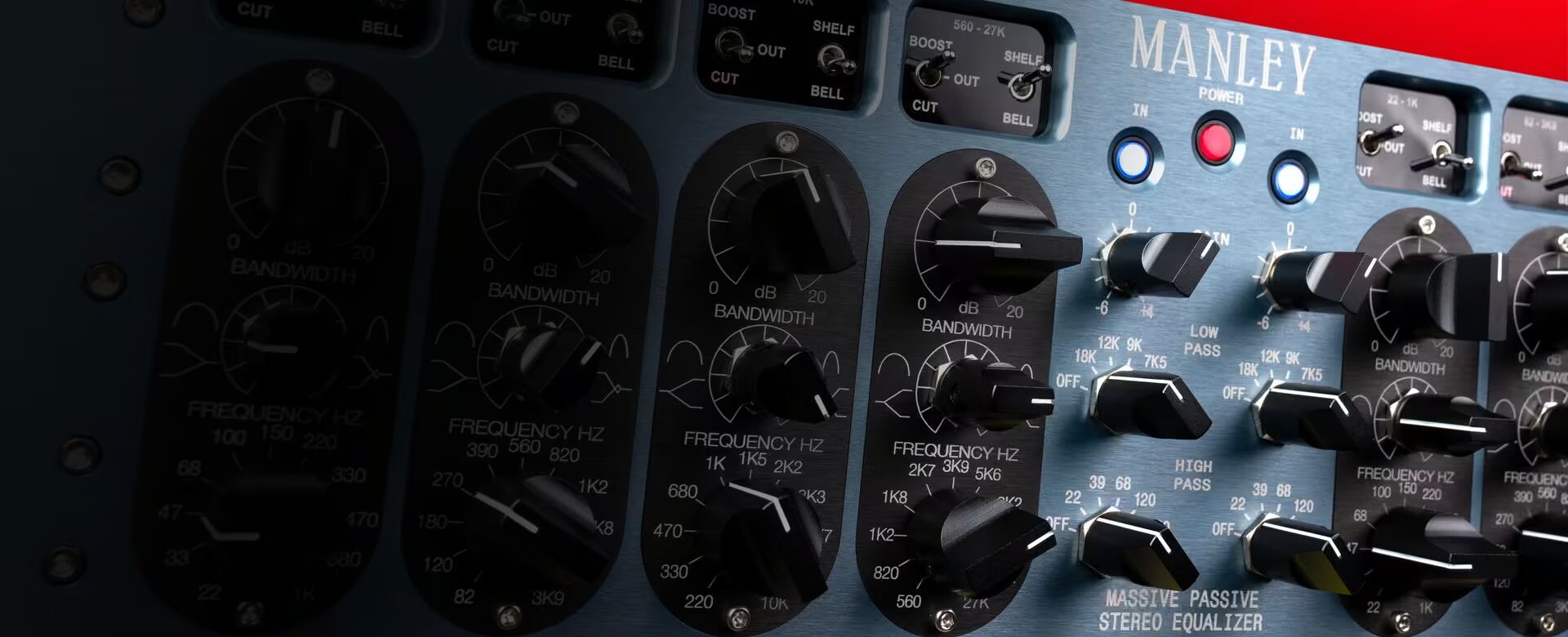
Manley: Website Relaunch from Squarespace to Nuxt and Strapi
Manley builds tube gear for recording studios and hi-fi. Its Squarespace site has been replaced by a custom-built website on Nuxt and Strapi.
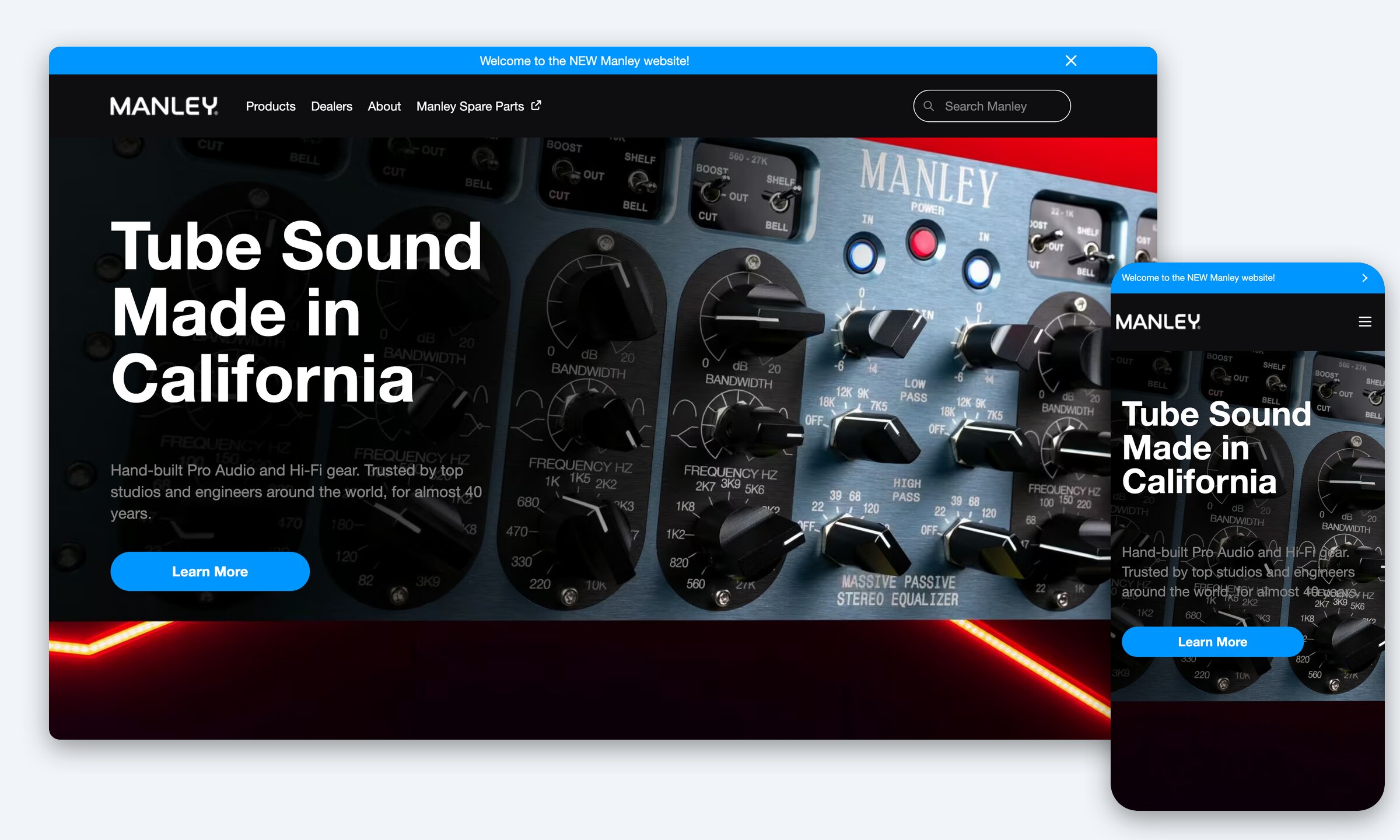
Manley.com after the relaunch
The new site
- Client
- Manley Laboratories, California
- Project
- Website relaunch and CMS migration from Squarespace
- Technology
- Nuxt, Strapi
- Scope
- 37 product pages in 11 categories
- Services
- Concept, development, migration
Why Manley needed a more flexible technical base
Initial situation & goals
Manley builds tube gear in California: microphones, preamps, equalizers, compressors. People who buy this kind of equipment read the specs first. They compare bandwidth and want to know which tubes are inside. The website has to handle that level of detail.
The old site ran on Squarespace and had carried that load for years. All the information was there, but as running text on one very long page per product. For its next step, Manley needed a base that could organize this knowledge.
The problem
Challenges
Everything on one page
Details, specs, reviews, FAQs and the mastering version were stacked in one document. It was so long that it needed its own jump navigation.
Product data as text, not as fields
Frequency response, distortion and price were paragraphs on the page. That made it impossible to highlight them or reuse them elsewhere.
Goals
Approach
Structure the product knowledge
Features, specs and FAQs should be stored separately so each can be shown where it is needed.
Make the product range easy to browse
Pro Audio and Hi-Fi should be organized by category instead of a flat list of product names.
Why Nuxt and Strapi
Approach
Nuxt and Strapi are our standard setup. For Manley, it was the right fit for a specific reason: the core of the job was the content model, not the design.
A site builder knows pages. Strapi knows products, categories, specs and FAQs as separate types. That is what lets the same value appear in several places without being maintained twice.
Technologies & tools
Strapi as the content model
Products, categories, specs and FAQs are their own content types, not paragraphs on a page.
Nuxt for the frontend
Server-side rendering, so product pages load fast and search engines can index them completely.
Migrating the existing content
Years of Squarespace pages were moved into this model product by product, including products that are no longer made.
The product page at the heart of the relaunch
Implementation
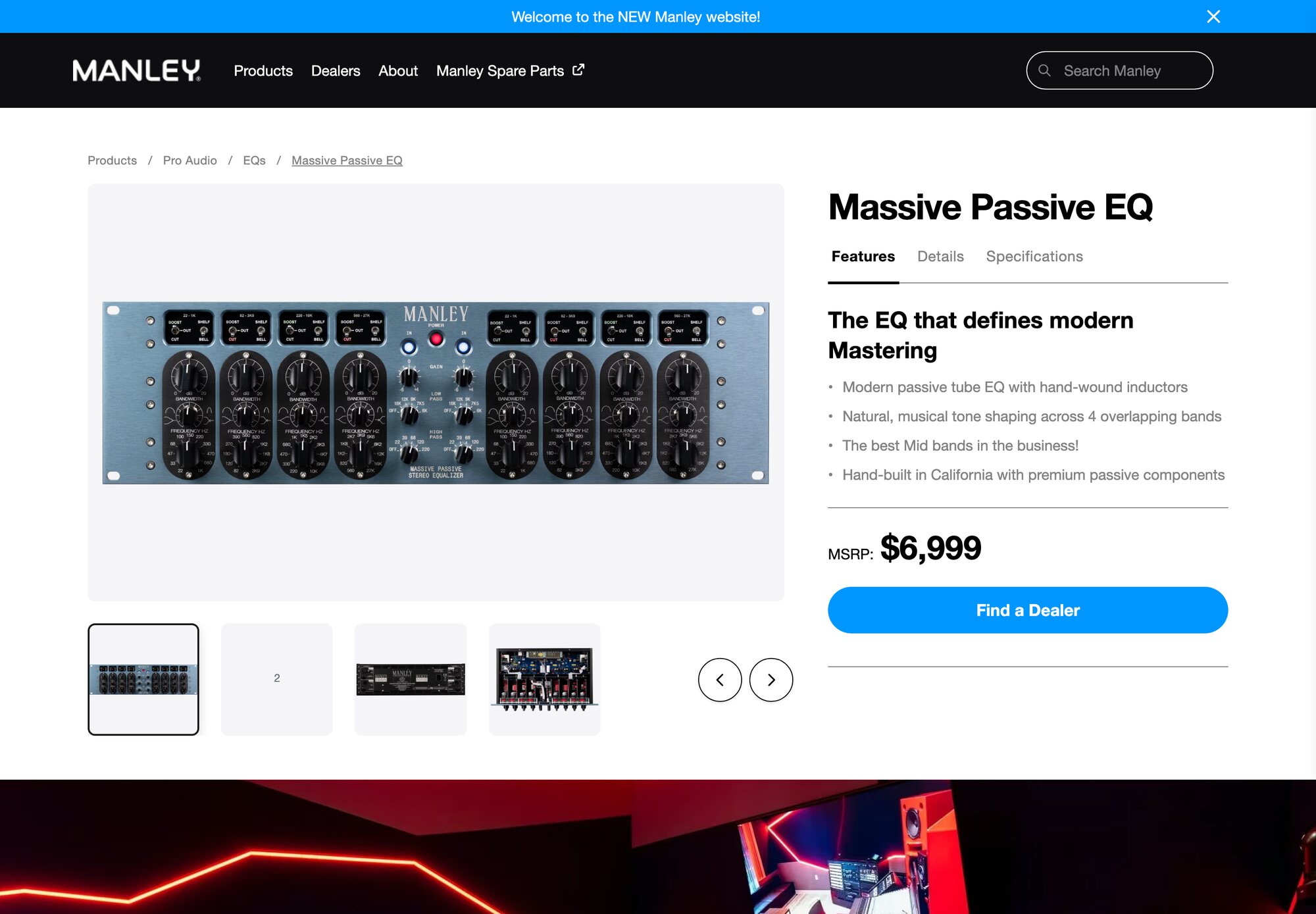
The Massive Passive page shows what mattered. It serves two very different visitors: someone seeing the unit for the first time, and a recording engineer looking for one specific value.
The answer is order, not length. At the top: images, key points, price and the way to a dealer. Below that, features, details and specs each get their own section, followed by the FAQs for this exact unit.
Core features
Specs as fields
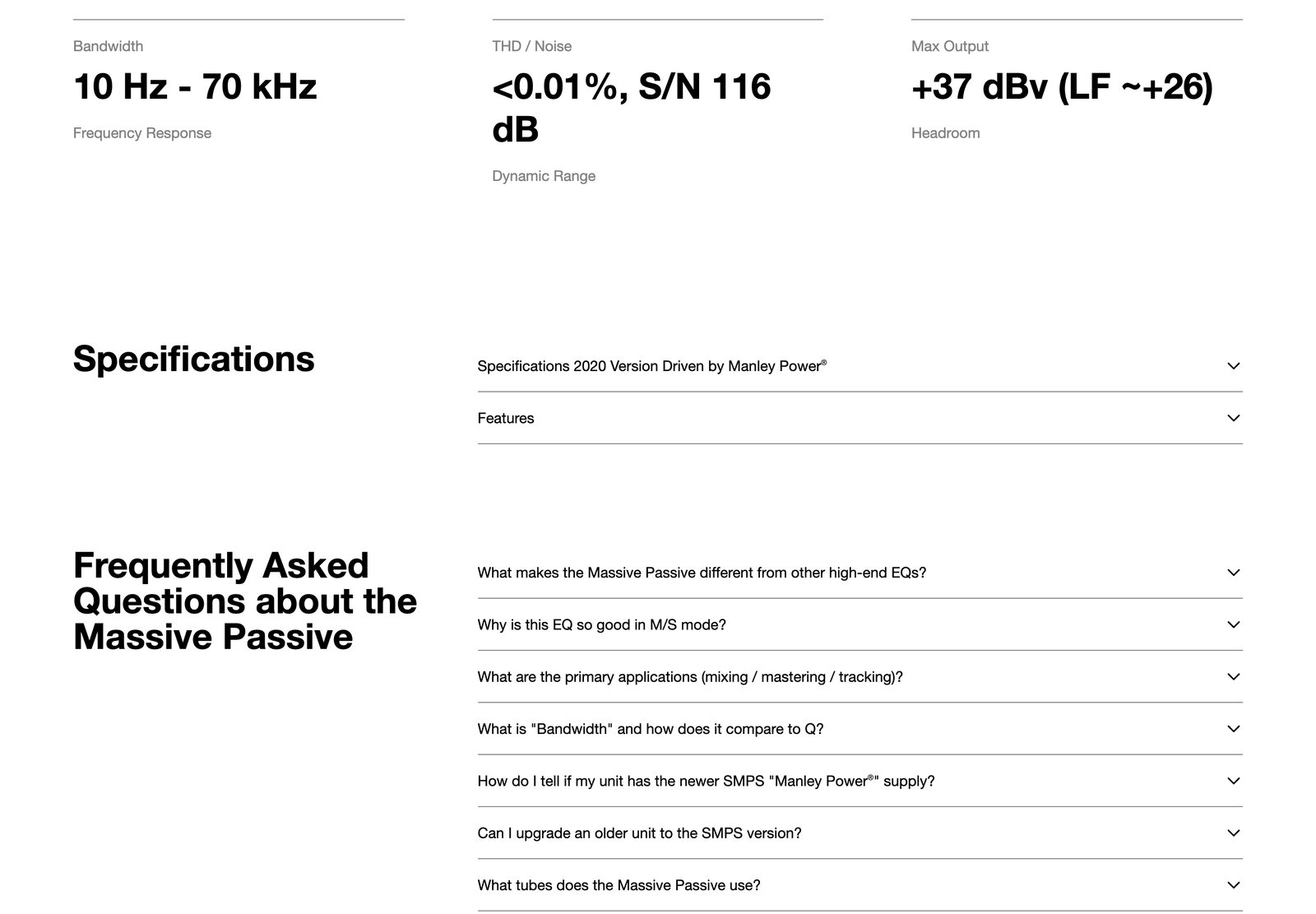
Bandwidth, distortion and headroom are stored as separate values. They can be highlighted instead of getting lost in the text.
Product categories for Pro Audio and Hi-Fi
Eleven categories, from channel strips to tube mics. A product can sit in several: the Massive Passive appears under EQs and under Mastering.
Readable URLs instead of product codes
/pro/msmp became /products/pro-audio/eqs/massive-passive-eq. The category is in the URL and in the breadcrumb.
FAQs as individual entries
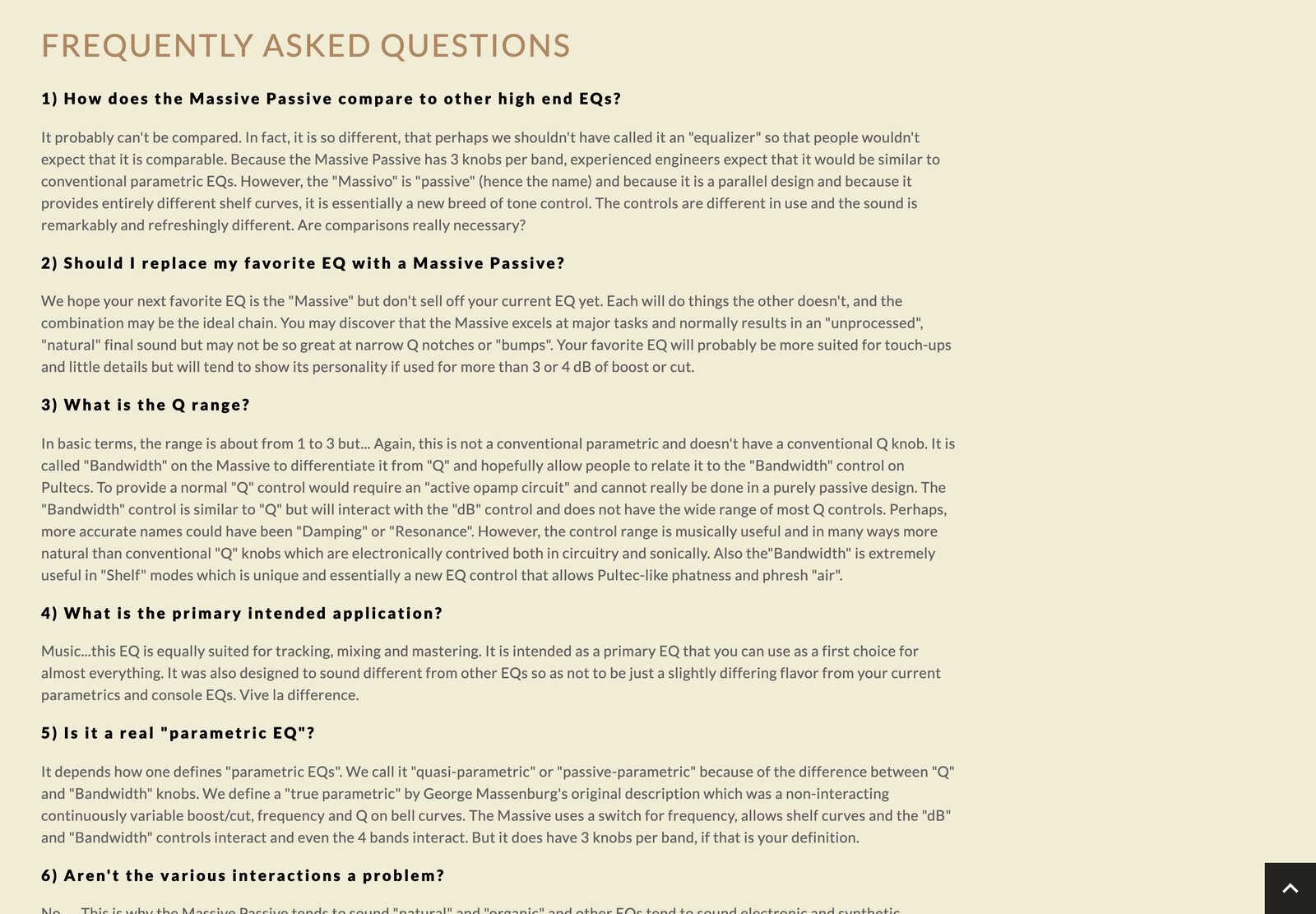
Each question about a product is its own entry and can be expanded, instead of a numbered block of text at the bottom of the page.
Current and discontinued products
Seven products that are no longer made have their own detail pages in a separate legacy section instead of disappearing from the site.
Updates without code changes
New products, changed specs and new FAQs are added in Strapi. The frontend keeps evolving on its own.
Overview at the top, depth below
Product page
The same information, organized differently
Before / after
Both screenshots show the product information for the Massive Passive: on the left, the page shortly before the relaunch; on the right, the page today.
What changed for Manley
Lessons learned
The relaunch is complete and Squarespace has been replaced. The new website has 37 product detail pages (19 Pro Audio, 11 Hi-Fi and 7 discontinued products) across 11 categories. In day-to-day work, this is what it means:
A new product is a record
Adding a product now means filling in fields: category, key values, FAQs. Before, it meant rebuilding a page.
Visitors browse by product range
Visitors find the right unit through categories. If they already know the name, a readable URL takes them straight to the product page.
Older products keep their place
Products that are no longer made live in their own section and can still be found through categories and search.
Bottom line
Squarespace served Manley well for a long time. But for a product range whose buyers read the specs before they decide, a site builder was the wrong level: it knows pages, not products. Manley now maintains product information, specs and content in a structured CMS, and the frontend can evolve independently. Visit Manley.com
Related services
More case studies
Other projects

Acon Digital
Acon Digital now sells its audio software fully automated: a download shop with licensing integration, data migration and multiple languages, built by Onveda.
E-CommerceRead
10 Phantom Rooms
10 Phantom Rooms presents its virtual instruments with a premium brand site: headless CMS, Native Instruments integration and a platform built to grow.
E-CommerceReadWant a website that fits your products better?
A relaunch, a move off a site builder, or a product range that needs more structure: we look at your site and tell you what is worth doing.

Jens Bohl Founder and Managing Director