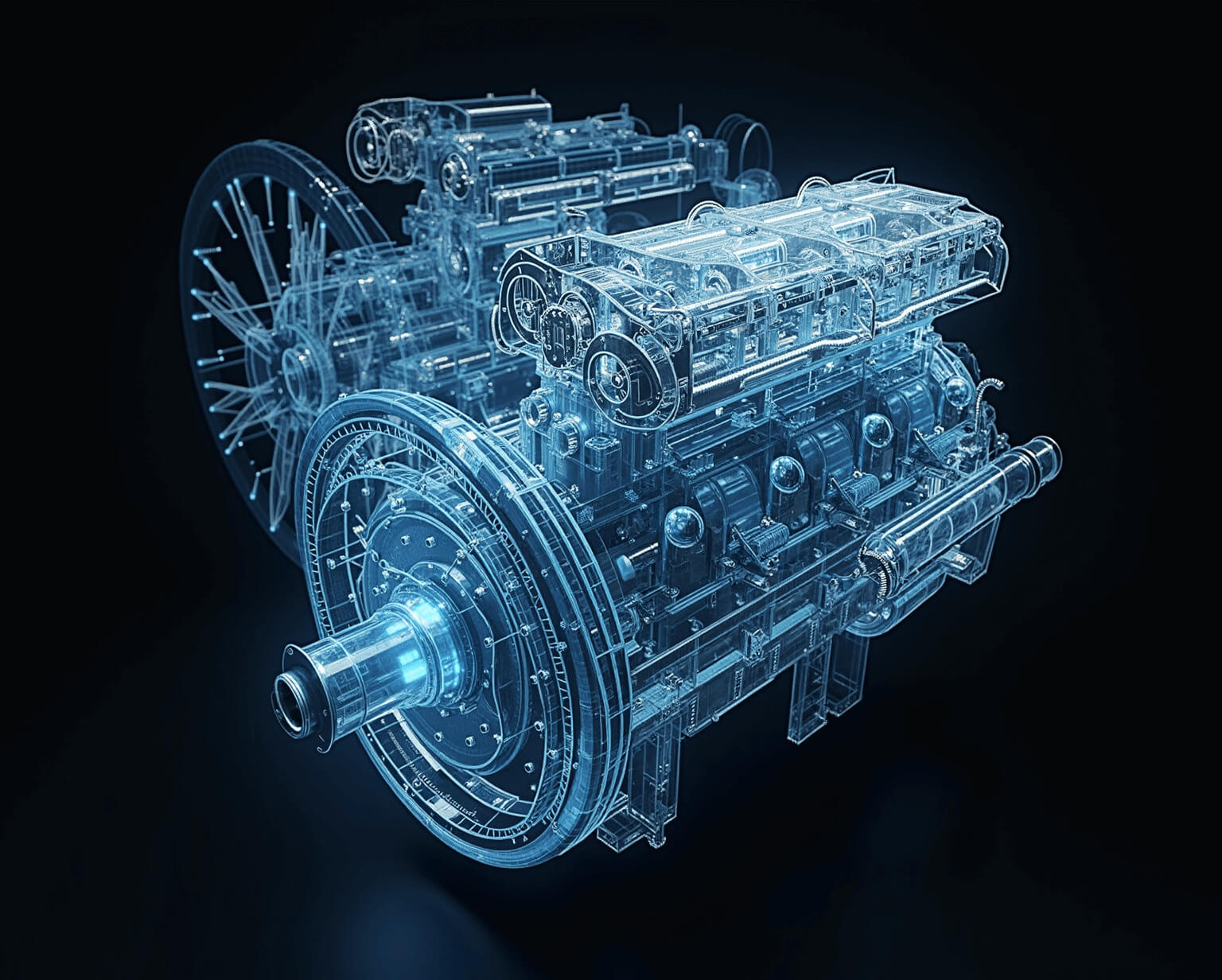
Digital Twin for Industrial Plants
Less unplanned downtime: digital twins for real-time monitoring and maintenance forecasts in industrial plants.
Solution example: how we implement a project like this. It does not describe a single client project.
Industrial Efficiency Through Digitalization
Initial situation & goals
Digital twins with real-time data and AI forecasts cut downtime, lower maintenance costs and improve production processes.
The problem
Challenges
Breakdowns
Typical starting point: machines stop unexpectedly because nobody saw the failure coming.
Maintenance
Fixed maintenance schedules cause unnecessary costs.
Optimization
Without real-time analysis, it is hard to increase output.
Goals
Approach
Real-time monitoring
Install IoT sensors for up-to-date data.
Process optimization
Reduce downtime with maintenance forecasts.
Visualization
Interactive 3D models of the plants.
Our Approach: IoT Meets Simulation
Approach
How we approach it: we combine IoT and AI to improve how the plants run.
Project management
Agile approach
Iterative development and testing to refine the features.
User-centered development
Regular feedback from operators guides each improvement.
Technologies & tools
IoT sensors
Capture real-time data from machines and equipment.
Machine learning
AI models predict when maintenance is needed.
3D rendering
Interactive plant models built with WebGL.
Team & roles
IoT specialists
Integrate the sensors and real-time data capture.
AI specialists
Build the machine learning models.
UX designers
Design an easy-to-use dashboard.
Implementation: Digital Twins at Work
Implementation
From data capture to real-time analysis: this is how a digital twin platform is structured.
Core functions
IoT sensors
- Real-time data from machines and equipment.
Predictive analytics
- Forecasts maintenance based on continuous data capture and analysis.
3D visualization
- Interactive models of the plants.
Dashboard
- Real-time data analysis for better decisions.
Technical features
Machine learning
- Deep learning models for reliable forecasts.
REST and WebSocket APIs
- Clean integration and real-time communication.
Cloud architecture
- Infrastructure that scales and stays up.
WebGL
- Renders interactive 3D models.
Takeaways and Outlook
Lessons learned
Lessons learned and the path to further improvements with digital twins.
Proactive maintenance
Digital twins make it possible to spot problems before they cause a stoppage.
Data-driven decisions
Real-time analysis improves strategic planning.
Scalability
The architecture leaves room for future extensions.
Next steps
Connect new sensor data sources.
Extend the 3D visualizations to more plants.
Refine the AI models for more accurate forecasts.
Bottom line
What it delivers: a digital twin shows the condition of industrial plants in real time, flags maintenance needs earlier and helps avoid unplanned stoppages.
Related services
More case studies
Other projects

Continuous Integration Pipeline (CI/CD Pipeline)
Solution example: a CI/CD pipeline with Jenkins, Docker and Kubernetes. Automated tests, a shorter path to deployment, fewer manual errors and closer collaboration between development and operations.
Continuous IntegrationRead
DevOps Optimization
The goal is shorter release cycles: automation across the board and CI/CD pipelines for predictable releases and higher quality.
DevOps & AutomationReadWhat are you working on?
On the first call, you tell us where things are stuck. We'll tell you honestly whether we're the right fit. 30 minutes, free.

Jens Bohl Founder and Managing Director